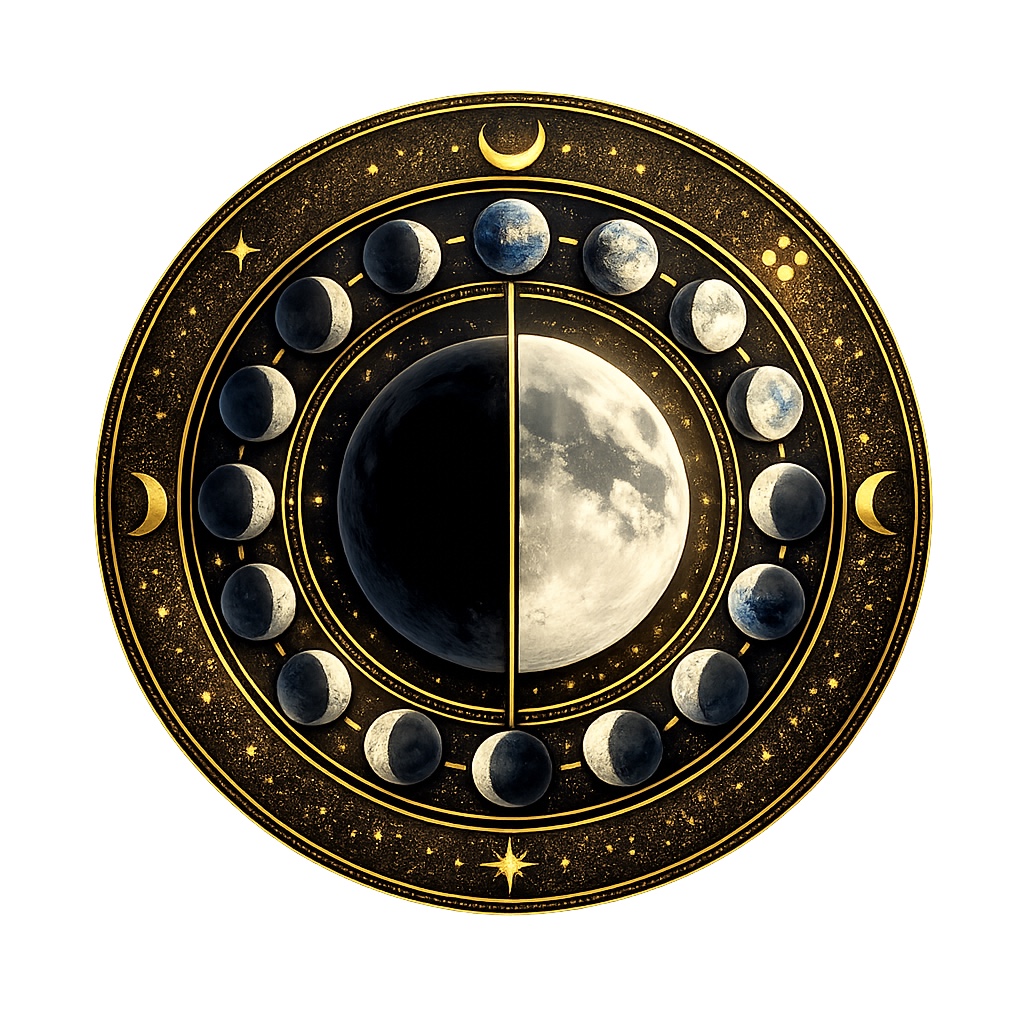
Earth view
People see the full Moon as a bright disk. That disk becomes the repeated symbol, ritual object, calendar marker, and familiar sky image.
At the moment of full Moon on Earth, a person on the Moon sees a new, dark Earth.
This is the entrance: a simple astronomical reversal before any adoption path. The viewer should feel the anti-phase shift first, then decide whether the work belongs in learning, public display, or design ethics.
From Earth: the Moon is bright. From the Moon: Earth is dark. Moon Dweller begins with that reversal.
Moon Dweller is not only a set of space animations. It is a perspective test: what is celebrated from one location may be hidden from another.
People see the full Moon as a bright disk. That disk becomes the repeated symbol, ritual object, calendar marker, and familiar sky image.
At that same moment, an observer on the Moon would see Earth in its new phase: dark, immense, and almost absent in light.
The series turns this anti-phase relationship into a cosmic visual sequence: Earth–Moon first, then other worlds and their own altered viewpoints.
Only the visible card is asked to play. This keeps the page alive for a lazy viewer while avoiding the confusion of all videos running at once.
Origin card
The core reversal: full Moon from Earth, dark Earth from the Moon. This card carries the whole project’s entry sentence.
Nearby world
The idea leaves Earth and tests another sky: a small moon, a red planet, and a different scale of watching. Artistic transfer prompt, not to scale, for observer-position reasoning only.
Giant planet frame
A moon-dweller under a giant planet sees scale differently: the sky is not a background but a dominating presence. Artistic transfer prompt, not to scale, for observer-position reasoning only.
Binary edge
A paired system turns the simple “viewer and object” relation into a mutual watch: two bodies locked into a shared field. Artistic transfer prompt, not to scale, for observer-position reasoning only.
Permanent split
The sequence moves from phases to a world where light and darkness become geography: one side held, one side hidden. Artistic transfer prompt, not to scale, for observer-position reasoning only.
Concept expansion
The final card asks the larger question: every observer has a sky, and every sky hides another point of view. Artistic transfer prompt, not to scale, for observer-position reasoning only.
The public page should sell the core idea first. The adoption paths come after the viewer has already watched the concept.
Phase 1
A short, teacher-ready module can turn the anti-phase idea into a classroom sequence: concept, visual, activity, and misconception check.
Best first proof: an open landing/download page.
Phase 1
The cards can work as a science-culture installation: visually memorable, but anchored to a clear mechanism rather than decoration.
Best first proof: prints, placards, and QR-linked loops.
Phase 1
The project can become a compact case study in truthful visualization: how labels, scale, contrast, and motion encode claims.
Best first proof: a visual-ethics appendix.
These links are kept simple for reviewers, educators, and exhibition teams who want to inspect the MP4 assets directly. Teachers should start from the dedicated educator package, which uses the Earth-Moon case only.
Independent science-culture project
Moon Dweller is built to be understandable first, then adaptable: for educators, public-space exhibits, visual communication, and future open-culture packages.
contact@moondweller.org